SMARTSAFE · PROFESSIONAL EQUIPMENT
Cell-level evidence before rebuilding a battery.
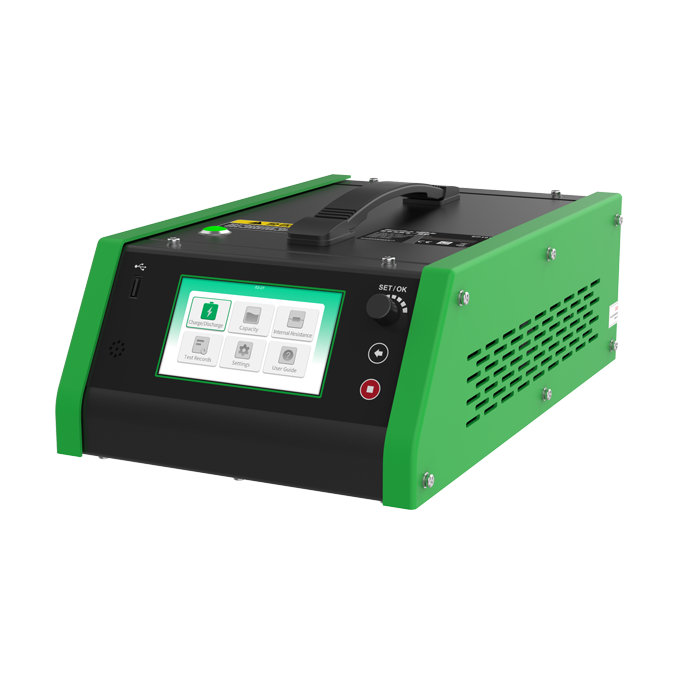
EP101 is a compact bench and on-site unit for individual EV battery cells. It combines controlled charge and discharge with capacity and DC internal-resistance testing, live readings and stored records. It is intended for cell screening, service and recycling evaluation, not for charging an assembled high-voltage pack.
At a glance
Up to 50 A
Constant-current charge and discharge from 0.5 to 50 A within a 250 W maximum.
Four chemistries
The product description names ternary lithium, LFP, lithium titanate and lithium manganese oxide cells.
Records you can export
Monitor live voltage, current, capacity, resistance and temperature; retain history and export via USB.
Functions in the workshop
Controlled cycling
Set constant-current and constant-voltage charging or constant-current discharging according to the cell specification. Voltage range is 1–5 V, with a maximum of 250 W.
Capacity assessment
Measure delivered or accepted capacity during a defined cycle and compare cells under the same test conditions. This supports sorting and verification during module repair.
Resistance and consistency
DC internal-resistance testing helps identify cells with different ageing or contact behaviour; compare readings at a consistent state of charge and temperature.
Isolated measurement
The product material describes isolated voltage/current sampling channels and output leads, helping reduce measurement interference when contacts are correctly fitted.
Temperature and fault handling
Monitor cell temperature. Listed protections include cell/system overtemperature, short circuit, reverse connection, disconnection, overcurrent and over/undervoltage.
Local operation and history
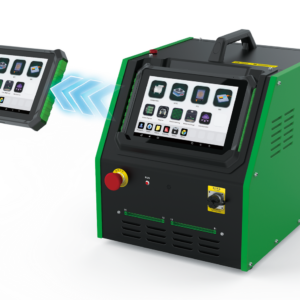
Use the 4.3-inch colour LCD, knob and button. Stored historical results can be exported by USB for traceability.
Suggested workflow
- Identify chemistry, rated voltage, capacity, temperature limits and the manufacturer’s allowed current.
- Secure correct polarity and measurement contacts to one isolated cell; attach temperature sensing as instructed.
- Choose charge, discharge, capacity or resistance procedure and set limits appropriate to the cell.
- Review the curve and recorded results, export history, then compare only cells tested under comparable conditions.
Technical specifications
| Parameter | Value |
|---|---|
| Cell voltage range | 1–5 V |
| Charge/discharge current | 0.5–50 A |
| Maximum charge/discharge power | 250 W |
| Voltage accuracy | ±0.2% FS + 5 mV at 5 V full scale |
| Voltage resolution | 0.001 V |
| Current accuracy | ±0.5% FS + 0.1 A at 50 A full scale |
| Current resolution | 0.1 A |
| Display / controls | 4.3-inch colour LCD · knob and button |
| Power input | AC 100/220 V · 50/60 Hz |
| Cooling | Forced air |
| Data export | USB |
| Operating / storage temperature | −10 to 60 °C / −20 to 70 °C |
| Ambient humidity | 10–90% RH |
| Ingress protection | IP21 |
Before ordering and use
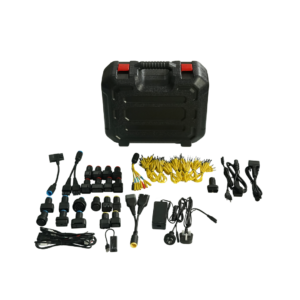
The 250 W power ceiling also limits usable current at a chosen voltage; 50 A is not guaranteed at every operating point. Use only with a single supported cell and follow chemistry-specific limits. Confirm test cables, temperature probe and regional mains lead in the delivered kit.